Start Here — What an AI Operator Does
2. The shift this course rests on
There is a quiet truth most AI conversations miss. The fear leaders express about AI is rarely about the technology. It is almost always a reaction to something else.
In executive conversations the concern usually sounds like this:
- What if it produces the wrong result?
- What if it goes too far?
- What if we cannot trust the output?
These are valid concerns, and they are usually misdiagnosed. The problem is not that AI is unpredictable. The problem is that AI is frequently deployed without defined intent, constraints, or validation criteria.
Organizations are not fearing AI. They are reacting to unstructured execution.
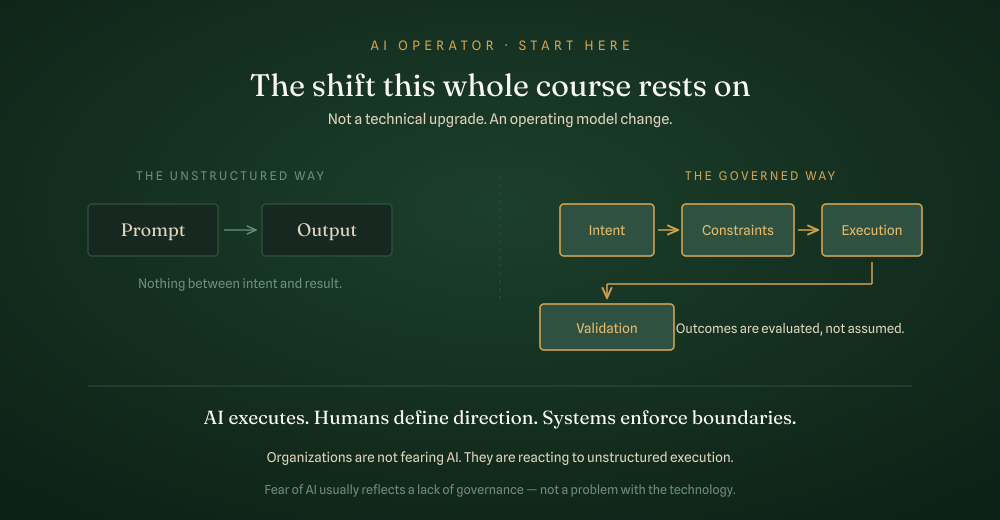
This is not a technical upgrade. It is an operating model change. AI executes. Humans define direction. Systems enforce boundaries. Outcomes are evaluated, not assumed.
Why most of what you have seen was never built to be governed
Demonstrations of AI building an application in minutes generate attention, sales, and adoption. Demonstrations of AI being correctly bounded, refused, validated, and corrected generate none of those.
So the industry optimizes for what looks impressive over what is governed. Capability sells. Constraint does not.
The consequence is practical: if you are modelling your practice on what you have seen demonstrated, you are likely building on a foundation that was never designed to be controlled.