Start Here — What an AI Operator Does
| Site: | DrBill360 Learning Portal |
| Course: | AI Operator |
| Book: | Start Here — What an AI Operator Does |
| Printed by: | Guest user |
| Date: | Friday, 28 August 2026, 2:59 AM |
Description
Read this before Module 1. What the role is, the shift the course rests on, the Four Questions, and how the framework got to its current form.
1. What an AI Operator does

The operator role is a governance role. The hard part was never the tool.
Generative and agentic AI systems now propose actions, decisions, and work products. Someone has to decide what they may touch, what they need to know, whether their output is acceptable, and whether the record of all that still holds.
That someone is an AI Operator.
Direct, govern, and orchestrate AI-augmented workflows in which AI systems propose actions, decisions, or work products that humans review, approve, modify, or reject inside a documented and auditable operating loop.
What it is not
The role is often confused with adjacent occupations. The distinction is worth holding, because it explains why existing job descriptions do not cover this work.
| Occupation | What they do |
|---|---|
| Data Scientists | Build models |
| Business Intelligence Analysts | Report data |
| Information Security Analysts | Defend systems |
| Computer Systems Analysts | Design technical systems |
| IS Managers | Run the IT function |
| AI Operator | Operates an AI-augmented workflow as a documented, auditable, accountable system |
None of the first five defines the governance-plus-orchestration discipline as a primary function. That gap is why this role is emerging as its own occupation.
This course is aligned to O*NET-SOC 15-1299.09 — Information Technology Project Managers.
2. The shift this course rests on
There is a quiet truth most AI conversations miss. The fear leaders express about AI is rarely about the technology. It is almost always a reaction to something else.
In executive conversations the concern usually sounds like this:
- What if it produces the wrong result?
- What if it goes too far?
- What if we cannot trust the output?
These are valid concerns, and they are usually misdiagnosed. The problem is not that AI is unpredictable. The problem is that AI is frequently deployed without defined intent, constraints, or validation criteria.
Organizations are not fearing AI. They are reacting to unstructured execution.
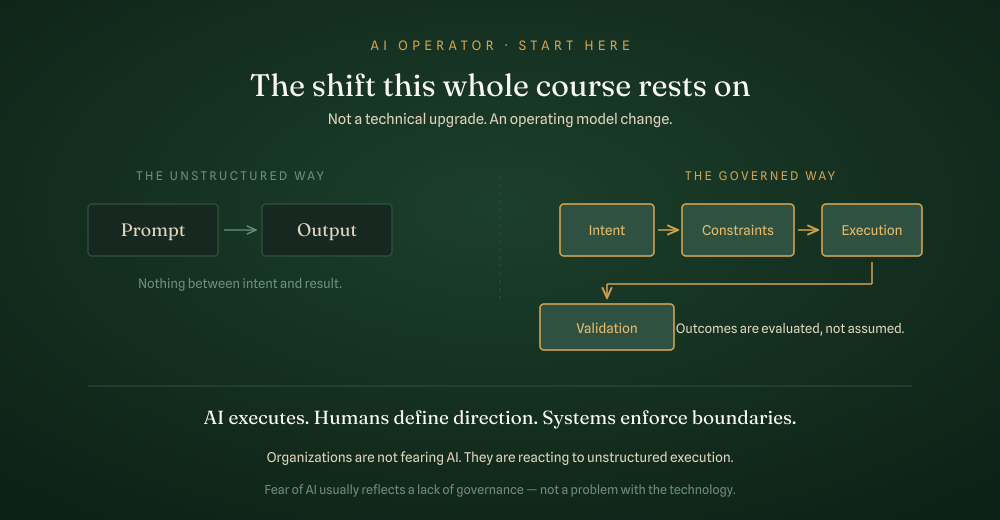
This is not a technical upgrade. It is an operating model change. AI executes. Humans define direction. Systems enforce boundaries. Outcomes are evaluated, not assumed.
Why most of what you have seen was never built to be governed
Demonstrations of AI building an application in minutes generate attention, sales, and adoption. Demonstrations of AI being correctly bounded, refused, validated, and corrected generate none of those.
So the industry optimizes for what looks impressive over what is governed. Capability sells. Constraint does not.
The consequence is practical: if you are modelling your practice on what you have seen demonstrated, you are likely building on a foundation that was never designed to be controlled.
3. The Four Questions
Before asking AI to do anything, you should be able to answer four questions.
- What is the intended outcome?
- What constraints must be respected?
- What does success actually look like?
- How will the results be validated?
If these cannot be answered first, the issue is not AI risk. It is lack of governance.
They will recur throughout this course. Each one anchors a discipline:
| Question | Discipline |
|---|---|
| What constraints must be respected? | Module 1 — Scope |
| What does the system need to know? | Module 2 — Context |
| What does success look like, and who says so? | Module 3 — Approval |
| How do we know that answer still holds? | Module 4 — Warrant |
Try answering all four, right now, for one piece of AI-assisted work you are currently responsible for. The one you cannot answer is where this course will be most useful to you.
4. How this framework changed
Frameworks that arrive fully formed should be treated with suspicion. This one did not.
An earlier published version named five disciplines: define intent, establish constraints, separate specification from context, validate outcomes, maintain human oversight.
The version you will learn names five different ones: scope, context, approval, warrant, strategic alignment.
What changed, and why
The first three of the current set absorb all five of the earlier ones — the earlier list was a more granular description of what is now Scope, Context, and Approval.
Two disciplines were added, and both came from operating the model rather than theorizing about it:
- Warrant — because written records that were true when made turned out to go false silently, and nothing in the earlier framework addressed decay.
- Strategic alignment — because governed AI that produces no organizational value is a well-run process with no purpose.
You will meet the same pattern in Module 4, where the discipline now called Warrant was first called Memory, and the name was changed after eighteen coded incidents showed that retrieval was never the failure.
Your operating model will change too. Model capabilities shift, and a framework that has not been revised in two years has stopped being tested against practice.
That is not a caveat about this course. It is one of its lessons.
5. How to work through this course
Five modules. Four in the Core track, one in the Strategic track.
| Module | The question it answers |
|---|---|
| 1 · Scope | What is in and out of bounds? |
| 2 · Context | What must the AI have in front of it? |
| 3 · Approval | Who accepts this, and against what standard? |
| 4 · Warrant | Can this record still be acted upon? |
| 5 · Strategic Alignment (Strategic track) | Did this produce organizational value? |
What each module contains
- A book carrying the teaching content
- Three assignments — each producing an artifact you can use at work the same week
- A forum on a genuinely contested question
- A journal entry, continuous across the course
- A knowledge check — 80% to pass, retakes allowed
The assignments are the real assessment
The quizzes check that you followed the reading. The assignments check whether you can do the work, and every one asks you to apply the discipline to a real workflow in your own organization rather than a case study.
Each also asks a direction question: not only did you build the artifact, but what problem was it for, and how would you know it worked? That question runs through every module, and it is the one most likely to change how you work.
To complete the Core track
Pass the Core Summative Assessment — 20 questions, 80% to pass — and your certificate becomes available. It carries a unique verifiable certificate ID and does not expire.

Work the modules in order. Each one assumes the last.