Strategic Alignment — Did This Produce Value?
| Site: | DrBill360 Learning Portal |
| Course: | AI Operator — Strategic Track |
| Book: | Strategic Alignment — Did This Produce Value? |
| Printed by: | Guest user |
| Date: | Friday, 28 August 2026, 2:57 AM |
Description
The fifth discipline: converting governed AI capability into organizational value you can prove. Five chapters.
1. Did this produce value?

Four disciplines can be done well and still produce nothing of value.
Modules 1 to 4 built an AI-augmented workflow that is bounded, informed, reviewed, and whose records hold.
All four can be done well and produce nothing of value. A governed process with no purpose is a well-run process with no purpose.
This module asks the question the Core track deliberately does not:
Did this produce organizational value — and how would you prove it to someone who did not want to believe you?
Why that second clause matters
You will be handed an AI initiative and asked to certify that it worked. Possibly this year. Quite possibly by someone who has already announced the result.
The instruments most of us reach for first — seats, logins, activity, completions — have all just become nearly free to produce in volume. You will be able to report something impressive. It will not be false, exactly. It will simply not be evidence of anything.
If you own evaluation where you work, this is about to become your problem whether or not you chose it.
2. Measurement that is not free to fake
Charles Goodhart's 1975 observation was that any statistical regularity collapses once it is used for control. The familiar restatement — when a measure becomes a target, it ceases to be a good measure — is Marilyn Strathern's (1997), and it is hers that is almost always quoted as his. AI has made this acute, because it collapsed the cost of moving the usual numbers.
Donald Kirkpatrick's four levels of evaluation — reaction, learning, behavior, results — supply the diagnosis. Most evaluation stops at the first two levels because those are the two that are easy to collect.
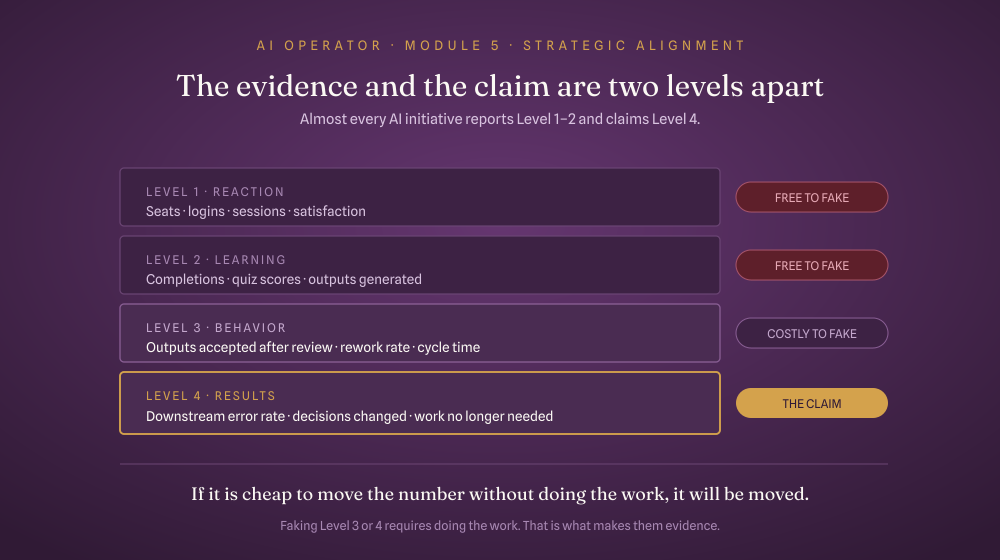
An AI initiative reporting enthusiasm and completions is reporting Levels 1 and 2. The claim being made — that the organization is better off — is a Level 4 claim. The evidence and the claim are two levels apart, and almost nobody says so out loud.
The operator's test
If someone wanted to move this number without doing the underlying work, how hard would it be?
| Metric | Cost to fake | What it actually evidences |
|---|---|---|
| Seats provisioned | Near zero | Procurement happened |
| Logins, sessions | Near zero | A tab was open |
| Completions | Near zero | Content was clicked through |
| Outputs generated | Negative — cheaper than not doing it | Capacity exists |
| Outputs accepted after review | High | Something met a standard |
| Cycle time on a named decision | High | A process changed |
| Rework rate | High | Quality changed |
| Downstream error rate | High | The organization changed |
The pattern: anything counting activity is cheap. Anything counting accepted work, or work no longer needed, is expensive — because faking it requires doing it.
Two tests worth carrying. A metric that improves when the AI is switched off is measuring the wrong thing. And a metric that gets worse when governance is added is measuring throughput, not value.
3. Reviewing against intent
Four questions after deployment. The order matters, and one of them is almost always skipped.
| Question | Common failure | |
|---|---|---|
| 1 | Accuracy — is the output right? | Sampled once at launch, never again |
| 2 | Efficiency — did it cost less? | Counts AI time, ignores review time |
| 3 | Alignment with intent — is it doing what we meant? | Never asked, because the task succeeded |
| 4 | Downstream impact — what changed elsewhere? | Invisible unless someone looks |
Question 3 is the one that gets skipped — and it is the one Direction exists to catch. A workflow can pass accuracy, efficiency and impact while doing something nobody intended, because the task was completed correctly and the problem it was meant to solve was never restated.
The efficiency trap
Most efficiency calculations count what AI saved and omit what review cost. If verification time is not in the denominator, the number is fiction — and the verification ceiling from Module 3 is precisely the cost being left out.
Evaluating tools, not just capability
Capability is the easy half, and the half vendors demonstrate.
| Criterion | The question |
|---|---|
| Capability | Can it do the work? |
| Boundability | Can its scope be constrained — and is the constraint enforceable? |
| Auditability | Does it record what it did and why? |
| Attributability | Can you tell which actor did what? |
| Exit cost | What does leaving cost — data, workflow, skills? |
Attributability is the one discovered too late. A platform where every action is logged under one shared service identity cannot support after-the-fact accountability, however complete the logs look. That is the Module 4 attribution failure arriving as a procurement decision rather than a bug.
4. What nobody budgets for
AI-augmented work does not slot into an unchanged organization. Three changes are required, and initiatives that defer all three have deferred their own results.
Role redesign
If the constraint is verification capacity, then the scarce role is not the producer — it is the reviewer. And reviewing is currently nobody's job description, which means it is being done in the margins of jobs designed for something else.
Capability development
The four Core disciplines are not intuitive. An organization deploying AI without teaching them is relying on individual judgment at exactly the point where judgment is hardest and least supported.
Policy updates
Approval tiers, retention, disclosure, escalation paths — most were written for a world in which every action had a human author. They do not fail loudly when that stops being true. They simply stop describing what happens.
The business case
The artifact this module produces. Six sections:
| Section | Must contain |
|---|---|
| Problem | The organizational problem, stated before any mention of AI |
| Intervention | What the workflow does, and its scope boundaries |
| Governance | Approval tiers, the record, who is accountable |
| Measurement | Metrics that survive the free-to-fake test, with baselines |
| Cost | Including review time and the three changes above |
| Rebuttal | What would show this was the wrong call |
The last row is not optional. A business case with no stated falsification condition is advocacy. That is Toulmin's rebuttal, arriving at the executive level.
5. Two questions worth arguing about
Both of these are live disputes. This course holds a position on each, and you are expected to argue against it if the evidence in your domain supports that. A certification that teaches only settled answers produces operators who fail on the first novel case.
ISO/IEC 42001 or NIST AI RMF?
| ISO/IEC 42001 | NIST AI RMF | |
|---|---|---|
| Form | Certifiable management-system standard | Voluntary framework — Govern, Map, Measure, Manage |
| Enforcement | External audit | Internal discipline |
| Gives you | A certificate procurement can demand | A way of thinking, adaptable |
| Risk | Certifying the management system rather than the outcomes | Holds exactly as well as internal will does |
This is Module 4 in the wild. ISO is enforceability with external backing. NIST is enforceability by internal will — espoused theory that has to be genuinely held. The real choice is about which failure your organization is more prone to.
Is governance an accelerator or a brake?
The position this course takes: structured organizations move faster, with less risk, and more durably.
The strongest case against. Governance carries real latency — review cycles, documentation, approval queues. In a fast market, first-mover advantage may exceed the cost of some bad output. Worse, over-governance produces shadow AI: people route around the process entirely, which is more dangerous than light governance. And the accelerator claim may be survivorship bias — we see the governed organizations that succeeded, not the ungoverned ones that also did.
Assignment 5.3 requires you to make that case, not the instructor's.
A limit on everything in this module
The measurement argument comes from a domain where outputs are documents and code, and quality is judgable within days. Where feedback loops run for years — clinical outcomes, safety, education — Level 4 evidence may be genuinely unavailable when the decision must be made. The honest position there is a stated proxy with its limitations named, not a confident number.
How long is your feedback loop, and what will you claim in the meantime?

Both questions are live. You are expected to argue against the instructor on either.