Warrant — Can This Record Still Be Acted Upon?
| Site: | DrBill360 Learning Portal |
| Course: | AI Operator |
| Book: | Warrant — Can This Record Still Be Acted Upon? |
| Printed by: | Guest user |
| Date: | Friday, 28 August 2026, 2:57 AM |
Description
The fourth discipline: whether a written record still justifies belief and authorizes action. Six chapters.
1. Can this record still be acted upon?
Warrant — the standing of a written record to justify belief and authorize action.
Three disciplines so far have asked what the AI may do, what it needs, and who accepts the result. This one asks about the records those disciplines produce: are they still true, and do they still bind?
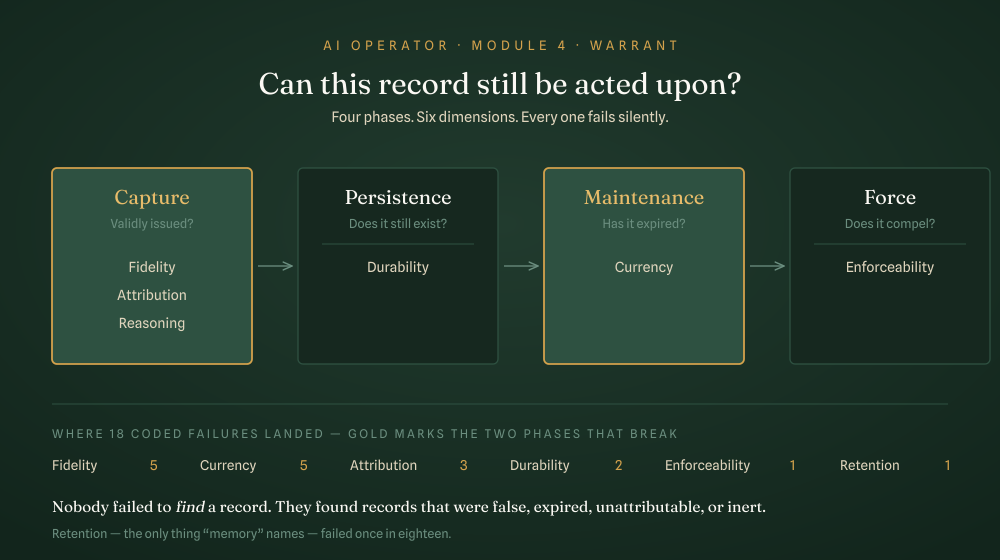
Warrant has four phases and decays along six dimensions. Every dimension fails silently.
| Dimension | Fails when… |
|---|---|
| Fidelity | The record was never true |
| Attribution | You cannot tell who claimed or decided it |
| Reasoning | The decision survives but the why is gone |
| Durability | A correct entry was made and did not survive |
| Currency | It was true when written and is not now |
| Enforceability | The rule exists and governs nothing |
The failure this discipline exists to prevent: acting on an expired warrant.
A note on the word
You may expect this discipline to be called memory. It was, in an earlier draft. The change came from evidence: across eighteen coded incidents in a live operation, nobody ever failed to find a record. Not once. They found records that were false, expired, unattributable, or inert. Memory implies storage and retrieval — and retrieval was never the problem.
2. Toulmin, applied to an operational record
The construct is new. Its parts are not — and naming the seminal authors is what separates a framework from a coinage.
In Stephen Toulmin's model of practical argument, a warrant is what licenses the move from grounds to claim. It is not the evidence; it is what entitles you to reason from the evidence to the conclusion.
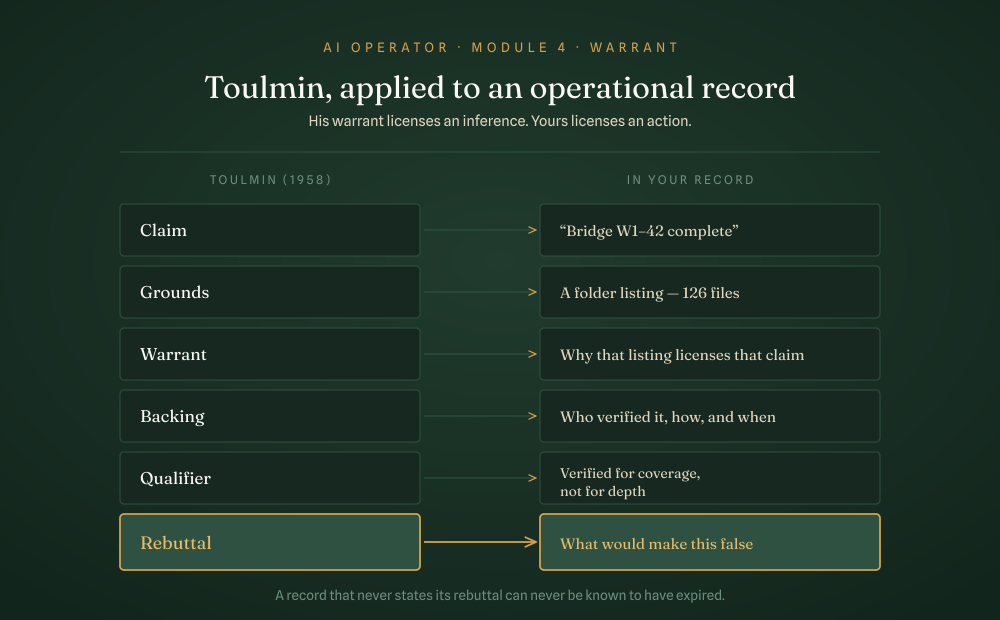
The extension this course makes: Toulmin's warrant licenses an inference. An operational warrant licenses an action. Same structure, different verb — plus time, because an action taken on Tuesday may rest on a warrant that expired on Monday.
Rebuttal is the borrowing that matters
Toulmin insists that a sound argument names the conditions that would defeat it. A record that does not state what would make it false can never be known to have expired.
Most organizational records state a claim and omit the rebuttal entirely. That omission is not a documentation gap — it is what makes decay invisible.
Supporting authors
- Walsh & Ungson on organizational memory — the literature this construct departs from. Their model treats the problem as storage and retrieval.
- Argyris & Schön, espoused theory versus theory-in-use — the enforceability dimension in classical form. A rule that is recorded, displayed, and governs nothing is an espoused theory with no theory-in-use behind it.
- Deming and the gemba tradition — go and see. What is new is applying it to a subordinate that produces confident, fluent, well-formatted claims at scale.
3. Why better recording will not fix it
The other disciplines fail loudly. Bad scope produces visible overreach. Missing context produces obviously wrong output. Weak approval ships a bad thing and someone owns it.
Warrant failure produces work that looks correct.
- A false record reads exactly like a true one.
- A stale record reads exactly like a current one.
- An unattributed entry is visually identical to an attributed one.
- A lost write leaves no gap where it should have been.
- An unenforced rule displays correctly in every interface built to show it.
No alert fires. Nothing errors.
This is why warrant is a maintenance and verification discipline rather than a documentation one — and why organizations that document diligently still run on expired warrants. The diligence is real. It is aimed at capture, and capture is the phase that was already working.
4. Six expired warrants
From a live multi-agent operation. Each is dated and traceable to a specific commit. Read them as claim, grounds, and the rebuttal nobody wrote.
Fidelity — "126 lessons complete"
Claim: an entire curriculum band was finished.
Grounds: a folder listing — 126 files, three per week, all 42 weeks.
The gap: the grounds licensed a claim about coverage. The claim made was about completion. A full-text audit found 14 real lessons and 112 outlines.
Missing rebuttal: nobody wrote "this count would be false if the files were outlines."
Currency — the row that idled a worker for two days
Claim: a task was outstanding, blocked on a missing tool.
True when written. The work completed; the row was never closed.
Consequence: a worker read it, behaved correctly, and sat idle for two days reporting a blocker that no longer existed.
The worker was not wrong. The record was.
Enforceability — the restriction that governed nothing
Claim: two activities were restricted to instructors.
Reality: the plugin that enforces role restrictions was not installed. The platform treated the unevaluable condition as permitted and surfaced no error. Students could open instructor material.
It displayed correctly in every interface. Espoused theory; no theory-in-use.
Attribution — 247 of 399
Claim: each commit records who did the work.
Reality: all workers commit under one shared identity; the infrastructure supplies no per-worker attribution. When a rule bypass occurred, the source could not be identified.
The compensation is a convention — a self-declared prefix. 247 of 399 commits carry it. Attribution here is enforced socially, not technically.
Durability — the correction that lost a race
Claim: a false status row was corrected.
Reality: the correction was written, then overwritten by a concurrent legitimate commit before it could land. The same mechanism then repeated on the entry recording it.
Not forgetting — the write happened and did not survive.
Reasoning — a standard that lived in a head
Claim: rebuilt work should "match the depth of the baseline."
Reality: the criterion was never written as something checkable. The reviewer graded "is this better than what it replaced?" — a question that always answers yes on a rewrite. Seven items were accepted that did not meet the standard.
The fix was not a better reviewer. It was writing the criterion down as a checklist that can be verified mechanically.

Every one of these records was written correctly. All six expired anyway.
5. Warrants that declare their own expiry
The same operation contains the counter-examples, and they share one move.
A scheduler configuration was recorded so it could be restored later. Days afterward, the recorded identifier had silently gone stale. The entry written after that discovery reads:
"Whoever resumes it should check the live list first, rather than assume this entry's id is still current — including this one."
That is a warrant stating its own rebuttal condition. The record tells the reader the circumstances under which it should not be trusted, and instructs them to re-derive rather than rely.
Three further instances in the same corpus:
- A role re-verified every cited reference before repeating it, rather than inheriting them.
- Standing rulings preserve reasoning, so settled questions are not re-litigated. One is annotated "raised in error three times — do not raise it again."
- The record documents its own failures, including the analyst's.
Self-invalidating documentation appears to be the highest-leverage practice available here — and it is a direct application of Toulmin's rebuttal. You are not writing what is true. You are writing what would make it false, so that a later reader can check.
6. Direction — what the systems did not catch
Three of the silent failures in the previous chapter were caught by a person refusing a confident report — not by any automated check.
- The completion claim was rejected by the principal after a coordinator had accepted it.
- A capability claim — "the tool cannot do this" — was refused, checked, and proved wrong.
- A "verified" status was disproved by walking the actual user path.
Direction is leadership, problem definition, and follow-up — exercised in the context of assessment, evaluation, impact, and desired results.
Read that against the failures and a pattern appears:
Every silent failure was a task completed correctly that did not solve the problem.
| Failure | Task as stated | Problem as it existed |
|---|---|---|
| The 126 lessons | Produce 126 files, three per week — done, exactly | Produce lessons someone could teach |
| The site summary | Set the summary text — done, exactly | Let a visitor find the free trial |
| The restriction | Restrict this to instructors — configured, exactly | Prevent students opening it |
In each case the worker performed. The task was satisfied and the desired result was not. No system catches that, because nothing was violated.
Why the three components are not optional
Problem definition keeps the task tethered to the outcome. A task delegated without a stated problem will be optimized as written — which is what a capable subordinate should do, and precisely why the drift is invisible.
Follow-up closes the loop against impact, not completion. A completion report answers "did you do it." Follow-up asks "did it work" — a different question, and only the director owns the desired result.
Leadership makes the first two survive contact with a confident answer. Refusing a fluent, well-formatted, plausible report costs something, and every incentive in an AI-augmented workflow rewards accepting it.
The AI half of this work is new. The direction half is not — and it is the half that caught what the systems missed.

Direction is what no system caught: the problem restated, and someone following up.