Warrant — Can This Record Still Be Acted Upon?
The fourth discipline: whether a written record still justifies belief and authorizes action. Six chapters.
2. Toulmin, applied to an operational record
The construct is new. Its parts are not — and naming the seminal authors is what separates a framework from a coinage.
In Stephen Toulmin's model of practical argument, a warrant is what licenses the move from grounds to claim. It is not the evidence; it is what entitles you to reason from the evidence to the conclusion.
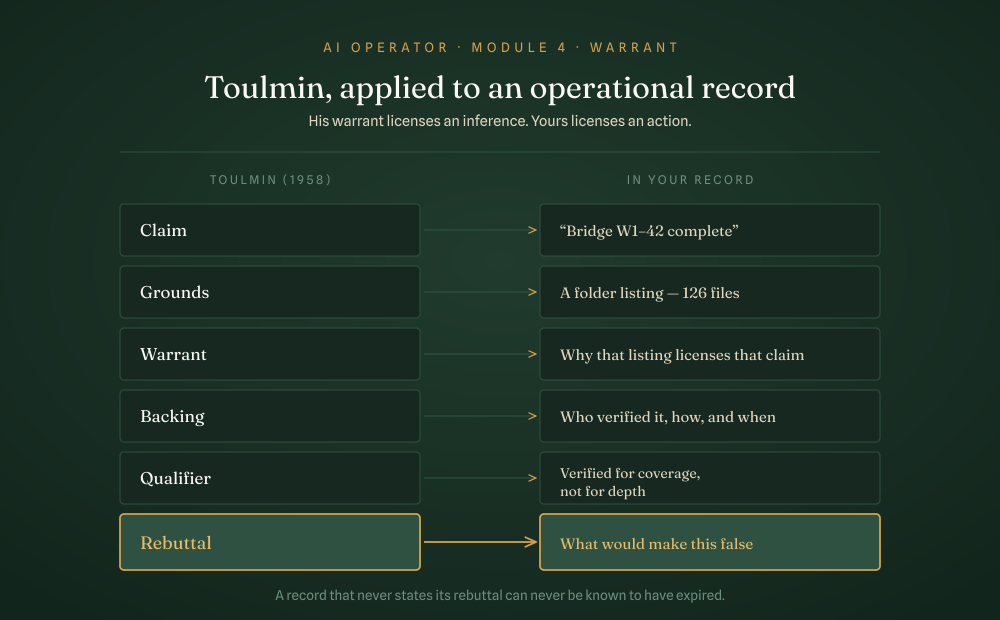
The extension this course makes: Toulmin's warrant licenses an inference. An operational warrant licenses an action. Same structure, different verb — plus time, because an action taken on Tuesday may rest on a warrant that expired on Monday.
Rebuttal is the borrowing that matters
Toulmin insists that a sound argument names the conditions that would defeat it. A record that does not state what would make it false can never be known to have expired.
Most organizational records state a claim and omit the rebuttal entirely. That omission is not a documentation gap — it is what makes decay invisible.
Supporting authors
- Walsh & Ungson on organizational memory — the literature this construct departs from. Their model treats the problem as storage and retrieval.
- Argyris & Schön, espoused theory versus theory-in-use — the enforceability dimension in classical form. A rule that is recorded, displayed, and governs nothing is an espoused theory with no theory-in-use behind it.
- Deming and the gemba tradition — go and see. What is new is applying it to a subordinate that produces confident, fluent, well-formatted claims at scale.