Strategic Alignment — Did This Produce Value?
The fifth discipline: converting governed AI capability into organizational value you can prove. Five chapters.
2. Measurement that is not free to fake
Charles Goodhart's 1975 observation was that any statistical regularity collapses once it is used for control. The familiar restatement — when a measure becomes a target, it ceases to be a good measure — is Marilyn Strathern's (1997), and it is hers that is almost always quoted as his. AI has made this acute, because it collapsed the cost of moving the usual numbers.
Donald Kirkpatrick's four levels of evaluation — reaction, learning, behavior, results — supply the diagnosis. Most evaluation stops at the first two levels because those are the two that are easy to collect.
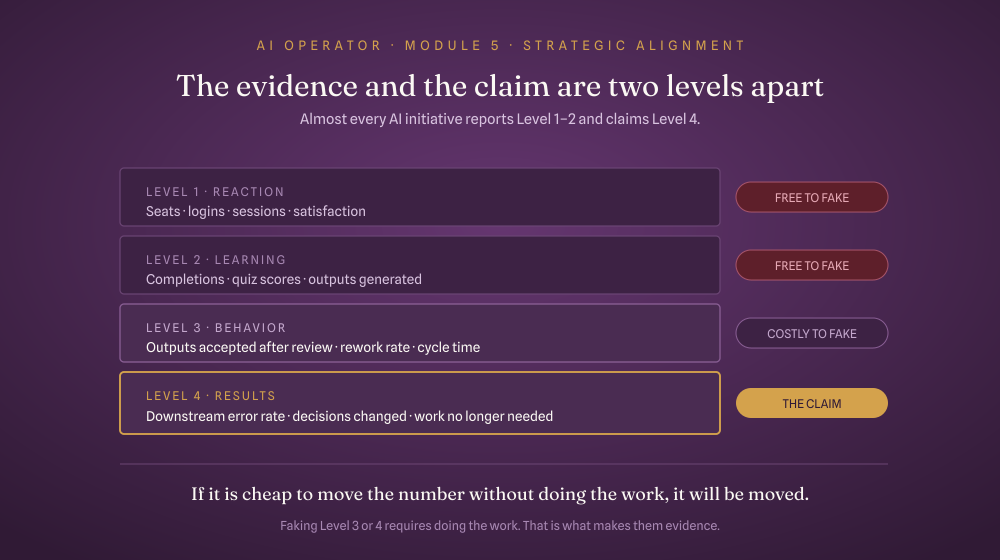
An AI initiative reporting enthusiasm and completions is reporting Levels 1 and 2. The claim being made — that the organization is better off — is a Level 4 claim. The evidence and the claim are two levels apart, and almost nobody says so out loud.
The operator's test
If someone wanted to move this number without doing the underlying work, how hard would it be?
| Metric | Cost to fake | What it actually evidences |
|---|---|---|
| Seats provisioned | Near zero | Procurement happened |
| Logins, sessions | Near zero | A tab was open |
| Completions | Near zero | Content was clicked through |
| Outputs generated | Negative — cheaper than not doing it | Capacity exists |
| Outputs accepted after review | High | Something met a standard |
| Cycle time on a named decision | High | A process changed |
| Rework rate | High | Quality changed |
| Downstream error rate | High | The organization changed |
The pattern: anything counting activity is cheap. Anything counting accepted work, or work no longer needed, is expensive — because faking it requires doing it.
Two tests worth carrying. A metric that improves when the AI is switched off is measuring the wrong thing. And a metric that gets worse when governance is added is measuring throughput, not value.