The CITM Method: The Invisible Architecture of Strategic Translation
Completion requirements
Use this model to evaluate or design programs that claim to support strategy but lack specificity:
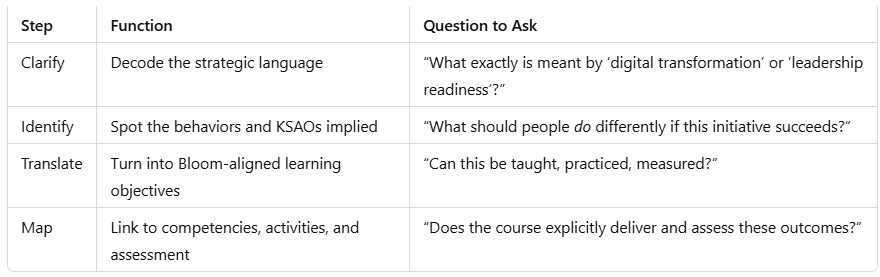
| Step | Function | Question to Ask |
| Clarify | Decode the strategic language | “What exactly is meant by ‘digital transformation’ or ‘leadership readiness’?” |
| Identify | Spot the behaviors and KSAOs implied | “What should people do differently if this initiative succeeds?” |
| Translate | Turn into Bloom-aligned learning objectives | “Can this be taught, practiced, measured?” |
| Map | Link to competencies, activities, and assessment | “Does the course explicitly deliver and assess these outcomes?” |
Note: Use of 'Transformation' (upstream) vs. 'Translation' (downstream)
🔁 Formation = upstream (vision, strategy creation)
-
Used when an organization is developing strategic intent or a cultural value.
-
e.g., “We are forming a culture of continuous development.”
🔄 Translation = downstream (implementation)
-
Used when strategic direction has already been set, and you now need to translate that into competencies, training, and KPIs.
-
e.g., “We’re translating our ‘digital readiness’ strategy into specific coaching capabilities.”
-
The organization already has strategies and initiatives.
-
The STZ is about testing and validating the translation of those into coachable, measurable development
Last modified: Tuesday, 1 April 2025, 12:23 AM